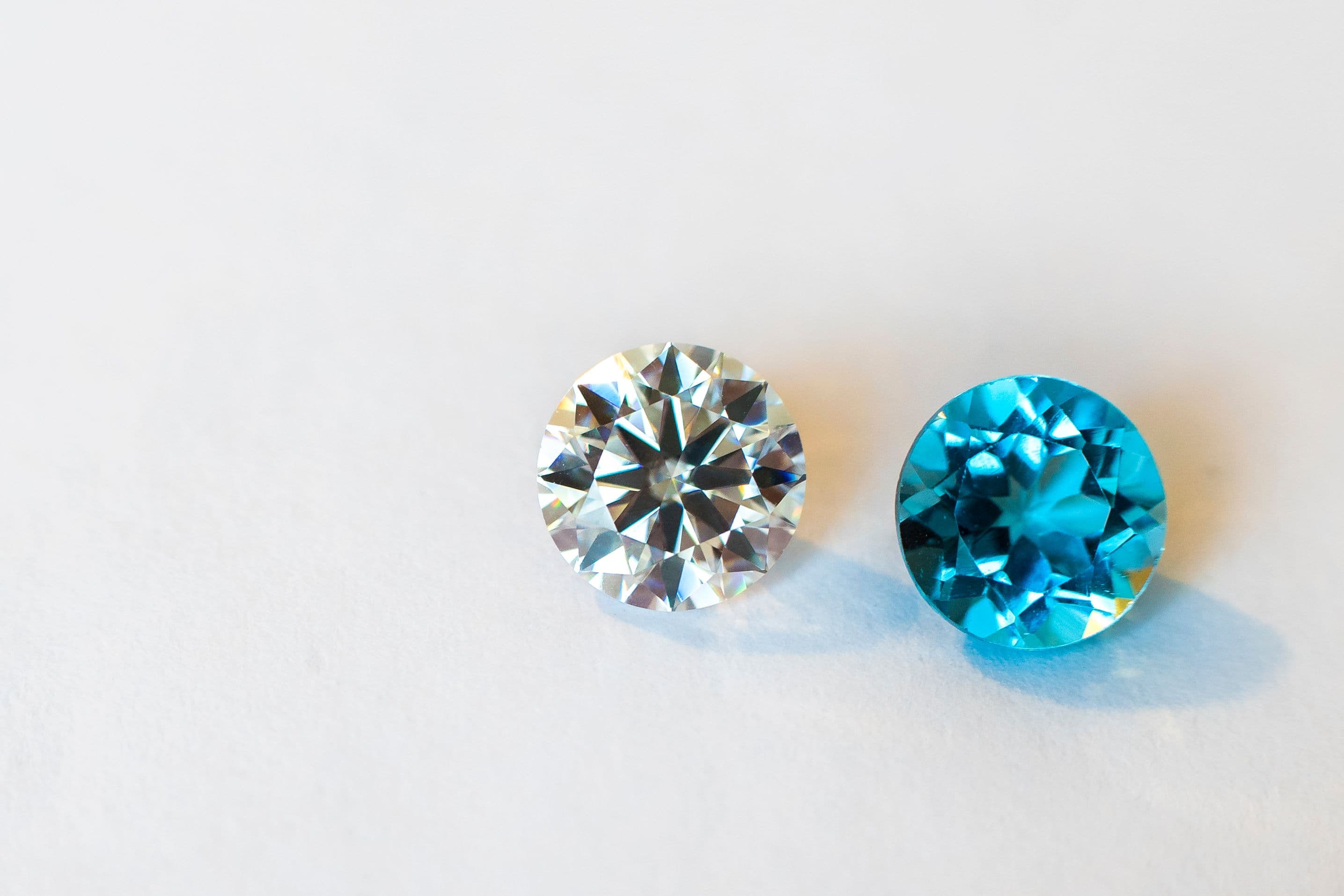
There is a number attached to every gemstone you have ever bought or considered buying, and most people who own fine jewellery have never heard of it. The Mohs scale runs from 1 to 10 and measures a stone's resistance to being scratched. Talc is 1. Diamond is 10. The number is useful, but the way most jewellers present it (as a simple ranking of stones from soft to hard) obscures the thing that actually matters for a buyer: not whether a stone can be scratched, but whether it can survive the specific conditions of how you intend to wear it.
I want to give you a more useful version of this information. Not the school science chart. The version that tells you whether your emerald engagement ring will survive five years of daily wear (it probably won't, for reasons that have nothing to do with the Mohs number), and why a jade bangle you can scratch with a steel file will outlast a poorly-set aquamarine ring you can't.
In Brief: The Mohs scale measures scratch resistance, not durability. A stone rated 7 or above will resist household dust (which contains quartz particles at Mohs 7) but may still chip, cleave, or shatter depending on its internal structure. The practical consequence for buyers: diamond, ruby, sapphire, and spinel are the only stones truly suited to everyday rings worn without care. Emerald, tanzanite, opal, and pearl require mindful wearing regardless of their Mohs rating. The setting matters as much as the stone.
Hardness is not toughness
The distinction is worth making clearly because it is the one piece of gemmological knowledge that changes buying decisions.
Hardness is scratch resistance; the Mohs scale measures this. A stone with a higher number can scratch a stone with a lower number. Quartz sits at 7, and quartz particles are present in household dust, in soil tracked in on shoes, on the surface of most kitchen worktops, and on many fabrics. Any gemstone rated below 7 on the Mohs scale will be scratched by dust over time. The lapis lazuli brooch you wear once a year is not affected by this. The pearl ring you wear every day is.
Toughness is resistance to breaking: to chipping, cleaving, or shattering under impact. This is where the Mohs scale becomes misleading if you take it in isolation. Diamond scores 10 for hardness and cannot be scratched by anything except another diamond. It also has four perfect cleavage planes along which it will split cleanly if struck in exactly the right direction. A hard enough knock on the corner of a diamond can chip it; not because it is soft, but because its crystal structure makes it directionally vulnerable. Jade scores 6 to 6.5, meaning steel will scratch it. It is also essentially impossible to break under normal conditions, because its interlocking microcrystalline structure distributes impact across the whole stone rather than focusing it at a weak point.
The practical implication: a stone's Mohs rating tells you how to clean and store it. Its toughness, cleavage properties, and internal condition tell you whether you can actually wear it daily.
The rule of 7
Here is the single most useful number in this article.
Household dust is primarily composed of quartz particles, which sit at Mohs 7. Any stone rated below 7 will be abraded by dust over time: not in a dramatic way, but cumulatively, wiping will cause microscopic scratches that progressively dull the surface. For a ring worn daily, this matters. For earrings worn occasionally, it matters less.
The practical threshold for everyday rings is Mohs 7 or above. Below that, you are buying something for occasional wear, regardless of how the jeweller presents it.
The wearability tiers
Tier 1: Wear without thinking (Mohs 8–10)
Diamond (Mohs 10): The only stone with no practical scratch risk from daily wear. The cleavage vulnerability exists but requires a directional impact most wearers will never encounter accidentally. For an engagement ring or a piece worn every day without removal, diamond remains the benchmark.
Ruby and sapphire (Mohs 9): Corundum (the mineral family both belong to) is the most practically durable of all coloured gemstones for jewellery purposes. It has no distinct cleavage planes, meaning it resists chipping as well as scratching. It tolerates hand sanitiser, dishwater, perfume, and the general environmental chaos of daily life. A well-set ruby or sapphire ring is the correct answer to "I want a coloured stone engagement ring I can wear without monitoring." For more on sapphire specifically, the sapphire buying guide covers what to look for in the stone itself.
Spinel (Mohs 8): Significantly underused and significantly underpriced relative to its durability. Spinel has no cleavage, excellent hardness, and a colour range that spans from the deep reds historically confused with ruby to vivid blues, pinks, and greys. For an active wearer who wants something that is not diamond, sapphire, or ruby, spinel is the most sensible choice in the category.
Topaz (Mohs 8): A note of caution despite the Mohs rating. Topaz has perfect basal cleavage: one direction in which it will split cleanly under impact. This makes it more vulnerable to chipping than spinel or corundum at the same hardness level. For a pendant or earrings where impact is unlikely, topaz is fine. For a ring worn daily, choose spinel or corundum instead.
Tier 2: Wear with some awareness (Mohs 7–8)
Aquamarine and morganite (Mohs 7.5–8): Both beryl family stones, both durable enough to resist daily scratching, both somewhat prone to accumulating surface oils that dull their brilliance over time. Clean regularly with warm water and mild soap. Avoid ultrasonic cleaners for morganite, which may have fracture fillings. Otherwise, both are reasonable everyday stones in protective settings.
Emerald (Mohs 7.5–8) — the exception that changes everything: Emerald sits at 7.5 to 8 on the Mohs scale, which places it in the same hardness tier as aquamarine. This is where the Mohs scale most dramatically misleads buyers.
Natural emeralds form in geological conditions that produce extensive internal fracturing (the jardin described in the emerald buying guide). These internal fractures, combined with the fact that approximately 99% of commercial emeralds are treated with oil or resin to disguise them, make emeralds structurally vulnerable in a way their Mohs rating does not reflect. A sharp knock against a granite worktop, a car door, or a heavy bag can shatter an emerald that would have survived that impact if it were aquamarine. The fractures are the weak points.
My view: emerald is not suitable as a daily-wear ring unless you are prepared to have it professionally inspected annually and accept that you may eventually lose the stone to impact damage. For pendants and earrings, where impact risk is significantly lower, emerald works well. For a ring worn occasionally to dinner or to evening events (where it will be admired but not stressed) it is one of the most beautiful stones available. For a ring worn while cooking, gardening, or commuting: it is the wrong choice.
Tourmaline and amethyst (Mohs 7–7.5): Both durable enough for daily wear in appropriate settings. Bezel settings, which wrap the stone in a protective border of metal, are the right choice for low-set tourmaline or amethyst rings where daily knocks are likely. Prong settings expose more of the stone and increase the impact risk.
Garnet (Mohs 6.5–7.5, depending on variety): The garnet family covers an enormous range: from the deep red almandines most people picture to the vivid green demantoid and the orange-red spessartine. Demantoid garnet sits at 6.5 and is best worn in earrings or pendants; almandine and pyrope at 7–7.5 are suitable for rings with some care. Tsavorite garnet at 7 to 7.5 is one of the more durable coloured stones for everyday earrings and pendants.
Tier 3: Wear mindfully (Mohs 6–7)
Tanzanite (Mohs 6–7): One of the most visually distinctive stones in fine jewellery (the blue-violet of fine tanzanite is unlike anything else) and one of the least practically suitable for everyday rings. Tanzanite has distinct cleavage in two directions, meaning impact from two angles can cause it to split. The correct use of tanzanite is in earrings or pendants for evening wear, or in a ring with a deeply protective bezel setting worn exclusively for occasions. A tanzanite ring worn daily will almost certainly be damaged within a few years.
Moonstone and labradorite (Mohs 6–6.5): Both feldspar family stones with pronounced cleavage and relatively low hardness. They are among the most visually striking stones available (the adularescence of moonstone, the labradorescence of labradorite) and both are best worn in earrings or pendants where their optical effects can be appreciated without the daily impact risk of ring wear. For drop earrings or a pendant, either stone is a reasonable choice.
Tier 4: Wear with care, always (Mohs below 6)
Opal (Mohs 5.5–6.5): Opal contains water (typically 3 to 10 percent by weight) which is what produces its play of colour and also makes it uniquely vulnerable. Opals can dry out, causing the surface to craze (develop a network of fine cracks). They are sensitive to sudden temperature changes, to prolonged exposure to dry conditions, and to household chemicals. They scratch relatively easily. The correct care instruction for a fine opal is: store it away from heat and dry air, keep it away from perfume and cleaning products, wear it for occasions not daily life. An opal ring worn constantly will not look the same in five years.
Pearl (Mohs 2.5–4.5): Organic, composed of calcium carbonate, and among the softest materials used in fine jewellery. Pearls are dissolved by acids: including the lactic acid in perspiration and the acids in perfume and hairspray. The correct wearing order is last on, first off: apply all cosmetics and fragrance before putting on pearl jewellery, and remove pearls before any chemical exposure. Store them in a soft pouch away from other jewellery that will scratch them. Pearls are not suited to rings for daily wear. For necklaces and earrings worn occasionally to appropriate occasions, they are one of the most classically beautiful options in jewellery.
The setting solution
A stone's durability can be meaningfully altered by how it is set, which means the jeweller's decisions are as important as the stone selection.
Bezel settings wrap the stone in a continuous perimeter of metal that rises to the girdle (the widest edge of the stone). This protects vulnerable stones (tanzanite, opal, lower-rated garnets) from direct impact and is the right choice for any stone you want to wear in a ring but have concerns about. The limitation is that bezel settings reduce the light that enters the stone from the sides, which can affect brilliance in transparent stones.
Prong settings expose more of the stone to light, maximising brilliance, but leave the stone more vulnerable to impact. V-shaped or pointed prongs protect the corners of marquise and pear-cut stones, which are the most vulnerable to chipping in those shapes. For stones below Mohs 8 in prong settings, regular inspection by a jeweller is worth doing annually; a worn or displaced prong is the most common cause of stone loss.
Closed-back settings, historically used for opals and some coloured stones, enclose the back of the stone in metal. They protect the stone but prevent examination of the back, which makes assessing condition and authenticity more difficult. Approach with care when buying second-hand.
Quick reference
| Stone | Mohs | Best use | Avoid |
|---|---|---|---|
| Diamond | 10 | Everyday rings | Nothing |
| Ruby, Sapphire | 9 | Everyday rings, all settings | Nothing with normal care |
| Spinel | 8 | Everyday rings | Nothing |
| Topaz | 8 | Pendants, earrings | Daily rings (cleavage risk) |
| Aquamarine, Morganite | 7.5–8 | Everyday wear, regular cleaning | Ultrasonic for treated stones |
| Emerald | 7.5–8 | Evening rings, pendants, earrings | Everyday rings |
| Tourmaline, Amethyst | 7–7.5 | Daily wear in bezel settings | Exposed prong settings for rings |
| Garnet (variety dependent) | 6.5–7.5 | Earrings, pendants, occasional rings | Daily rings for softer varieties |
| Tanzanite | 6–7 | Evening earrings, pendants | Rings of any kind for daily wear |
| Moonstone, Labradorite | 6–6.5 | Earrings, pendants | Rings |
| Opal | 5.5–6.5 | Occasional pendants, earrings | Daily wear, heat, chemicals |
| Pearl | 2.5–4.5 | Necklaces, earrings for occasions | Rings, chemical exposure |
Frequently asked questions
What is the Mohs scale and why does it matter for jewellery?
The Mohs scale is a measure of scratch resistance running from 1 (talc) to 10 (diamond), developed by the German mineralogist Friedrich Mohs in 1812. For jewellery buyers, the key threshold is 7 — quartz, which is present in household dust, sits at Mohs 7. Any stone rated below 7 will be abraded by dust particles over time, progressively dulling its surface. Stones rated 7 or above resist this. The scale measures hardness only, not toughness or overall durability; a stone can be very hard and still chip or shatter depending on its internal structure.
Can I wear an emerald ring every day?
Not advisably. Despite sitting at Mohs 7.5–8, natural emeralds contain internal fractures (jardin) that make them structurally vulnerable to impact. A knock against a hard surface can shatter an emerald that would survive the same impact if it were aquamarine at the same hardness. For an engagement ring worn daily, sapphire or spinel are significantly more practical. For a ring worn to evening events rather than daily life, emerald is a beautiful and reasonable choice.
What is the most durable coloured gemstone for an engagement ring?
Ruby or sapphire (both corundum, Mohs 9) are the most practically durable coloured stones for an engagement ring. They resist scratching, have no significant cleavage planes, and tolerate the conditions of daily life without damage. Spinel (Mohs 8) is an excellent alternative with similar durability. For buyers who want a coloured stone engagement ring they can wear without monitoring, these three are the correct choices.
What is the difference between hardness and toughness in gemstones?
Hardness measures a stone's resistance to being scratched, rated on the Mohs scale. Toughness measures resistance to breaking: chipping, cleaving, or shattering under impact. A stone can be hard but not tough: diamond (Mohs 10) is the hardest natural material but has cleavage planes along which it can chip under a hard directional impact. Jade (Mohs 6–6.5) is relatively soft and scratches easily, but its interlocking crystal structure makes it nearly impossible to break. Both properties matter for jewellery wearability.
Are pearls suitable for everyday wear?
Not for rings, and only with consistent care for necklaces and earrings. Pearls sit at Mohs 2.5 to 4.5 and are dissolved by acids including perfume, hairspray, and perspiration. The correct order is always last on, first off: apply all cosmetics and fragrance before putting on pearls, remove them before any chemical exposure. Store them in a soft pouch. Worn and stored correctly, pearls last; worn carelessly, they deteriorate within years.
What setting is best for a fragile gemstone?
A bezel setting, which wraps the stone in a continuous border of metal rising to its girdle, provides the most impact protection for fragile or lower-rated stones. It is the right choice for tanzanite, opal, moonstone, and lower-rated garnets in ring settings. Prong settings expose more of the stone to light, maximising brilliance, but leave it more vulnerable to direct impact. For stones below Mohs 7 that you want to wear in a ring, a bezel setting significantly extends the stone's practical life.
Sources: GIA gemstone hardness and toughness standards; Mohs scale mineralogical reference; current UK retail and gemmological practice, 2026.


